

Jobs That AI Can’t Replace: Why Human Work Still Matters More Than Ever
As artificial intelligence and generative AI grow, a recurring question appears across the job market and in discussions from tech companies to the World Economic Forum:
If AI can do so much, what jobs are safe?
This is not merely hype about chatgpt or AI chatbots; it’s a practical conversation about how human skills and the human touch remain essential even as businesses use AI to help scale work.
Despite rapid ai automation and headlines claiming roles will be replaced by ai, there are many jobs that AI can’t replace — not because ai technology is weak, but because certain occupations require qualities ai can’t replicate, such as interpersonal skills, moral judgment, and hands-on creativity.
Below we break this down clearly and realistically, noting which types of jobs are least likely to be replaced in 2025 and beyond and which roles are more likely to be affected by ai and automation.
What Do We Mean by Jobs That AI Can’t Replace?
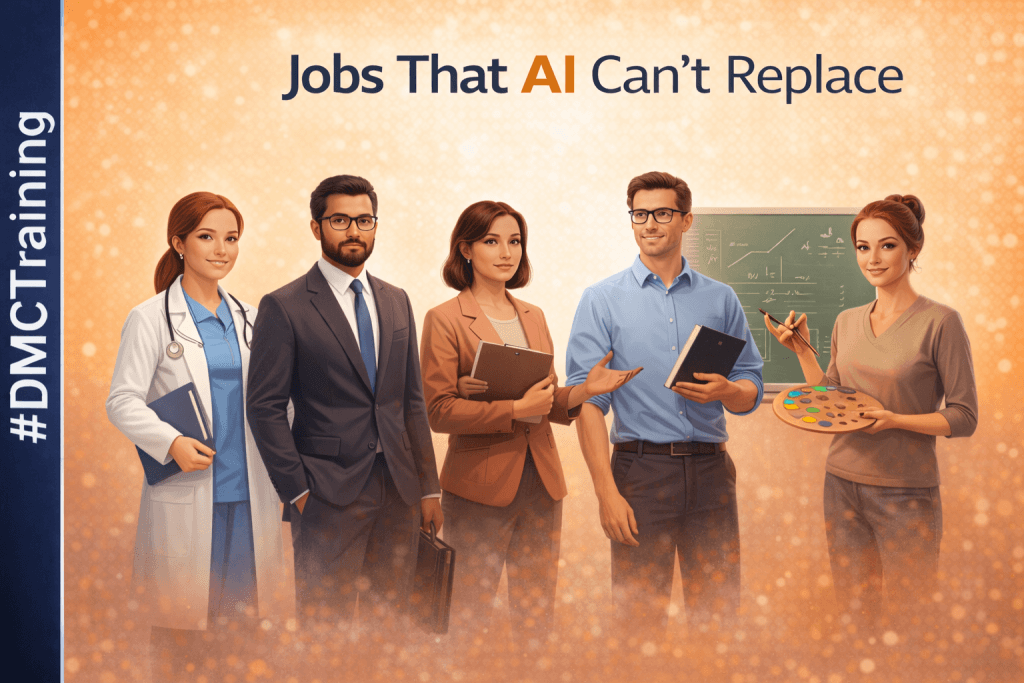
Jobs that AI can’t replace are occupations that depend heavily on human traits such as:
- Emotional intelligence and the human touch — roles like therapists and social workers that rely on deep interpersonal skills
- Moral and ethical judgment — leaders and judges who must weigh values beyond data
- Creativity and original thinking — creative jobs, designers, and artists where ai can assist but not fully replace imagination
- Complex social interaction and accountability — teachers, managers, and healthcare jobs that require responsibility and presence
- Problem-solving that integrates context and lived experience — emergency responders and skilled trades performing tasks ai simply can’t do
These jobs sit at the heart of many ongoing AI challenges, especially when organisations overestimate what ai models and robotics and ai systems can responsibly do. In the age of ai, careers that ai won’t replace are often those that require creativity, moral choice, and a human worker’s ability to connect and adapt in unpredictable environments.
Why AI Struggles to Fully Replace Humans
To understand jobs that AI can’t replace, we first need to understand AI’s limitations.
Despite impressive capabilities, AI still cannot:
- Feel empathy
- Understand lived human experience
- Make value-based decisions
- Take responsibility for consequences
These limitations are central to challenges in artificial intelligence and explain why human judgment remains essential.
1. Leadership and Executive Roles
Leadership is often misunderstood as decision-making alone.
In reality, leadership involves:
- Setting vision and values
- Managing conflict
- Navigating uncertainty
- Inspiring trust
AI can analyse options, but it cannot lead people.
This makes executives, managers, and founders one of the most important categories of jobs that AI can’t replace.
Removing human leadership introduces severe AI challenges in business — including loss of culture and accountability.
2. Healthcare and Caregiving Professions
While AI can assist with diagnosis and data analysis, healthcare is fundamentally human.
Doctors, nurses, therapists, and caregivers rely on:
- Empathy
- Ethical judgment
- Patient trust
- Emotional support
This is why fully automated healthcare remains unrealistic — and ethically risky.
Healthcare highlights one of the most critical problems with AI: accuracy without compassion is not enough.
3. Educators and Teachers
Education is not just information delivery.
Effective teachers:
- Adapt to student emotions
- Build motivation
- Mentor and guide
- Shape character
AI can support learning, but replacing teachers entirely would strip education of its human dimension.
This makes educators one of the most stable jobs that AI can’t replace — even as teaching methods evolve.
4. Creative and Artistic Professions
AI can generate art, music, and stories — but generation is not creation.
Creative work involves:
- Cultural context
- Emotional expression
- Original perspective
AI recombines patterns. Humans create meaning.
This distinction sits at the core of human vs AI debates and explains why designers, writers, artists, and filmmakers remain essential.
5. Psychologists, Counsellors, and Therapists
Mental health care relies on:
- Deep trust
- Emotional presence
- Ethical responsibility
AI may assist with tools and screening, but it cannot replace genuine human connection.
This is one of the clearest examples of jobs that AI can’t replace, despite increasing automation in healthcare services.
6. Negotiation, Mediation, and Diplomacy Roles
Negotiation is not just logic — it’s emotion, power, timing, and empathy.
Diplomats, mediators, and negotiators rely on:
- Reading human behaviour
- Managing tension
- Cultural sensitivity
AI cannot truly navigate these complexities without human guidance.
Replacing these roles would escalate AI challenges rather than solve problems.
7. Ethics, Governance, and Compliance Roles
As AI expands, demand for human oversight increases.
Roles related to:
- Ethics
- Governance
- Legal interpretation
- Compliance
Are becoming more important, not less.
Ironically, as automation grows, humans are needed to manage AI challenges and opportunities responsibly.
8. Skilled Trades and Hands-On Professions
Not all automation occurs in digital spaces.
Skilled trades require:
- Physical dexterity
- On-the-spot problem solving
- Environmental adaptation
Electricians, plumbers, craftsmen, and technicians operate in unpredictable environments — something machines still struggle with.
This makes them practical examples of jobs that AI can’t replace.
The Common Pattern Behind Jobs AI Can’t Replace
When you examine these roles closely, a clear pattern emerges.
These jobs require:
✅ Trust
✅ Accountability
✅ Emotional intelligence
✅ Contextual decision-making
✅ Ethical responsibility
These qualities represent ongoing challenges in artificial intelligence — not short-term technical gaps.
The Real Threat Is Not AI — It’s Role Misunderstanding
The biggest error organisations make is assuming automation can replace judgment.
When that happens:
- Customer confidence drops
- Employee trust erodes
- Ethical failures increase
This becomes one of the most dangerous problems with AI in modern organisations.
How Humans Stay Relevant in an AI-Driven World
People who thrive alongside AI:
✅ Develop critical thinking
✅ Strengthen communication skills
✅ Build emotional intelligence
✅ Learn to work with AI tools
The future doesn’t eliminate these jobs that AI can’t replace —
It rewards them.
AI Reveals What Makes Us Human
So why do jobs that AI can’t replace matter?
Because they remind us that:
- Technology is not wisdom
- Speed is not judgment
- Automation is not humanity
AI can assist humans — but it cannot replace purpose, values, or responsibility.
The jobs that survive will not be the most technical.
They will be the most human.