

Will AI Replace Human Jobs? The Reality Behind the Fear
Few questions create more anxiety in the workplace than this one:
Will AI replace human jobs?
Scroll LinkedIn, watch tech news, or sit in a boardroom long enough, and you’ll hear the same concern repeated in different forms:
- “Will AI take my job?”
- “Are we training machines to replace ourselves?”
- “What jobs will disappear next?”
This fear isn’t irrational.
But it is often misdirected.
To understand what’s really happening, we need to separate hype from reality and look honestly at how AI is affecting work today.
What Does “Will AI Replace Human Jobs” Actually Mean?
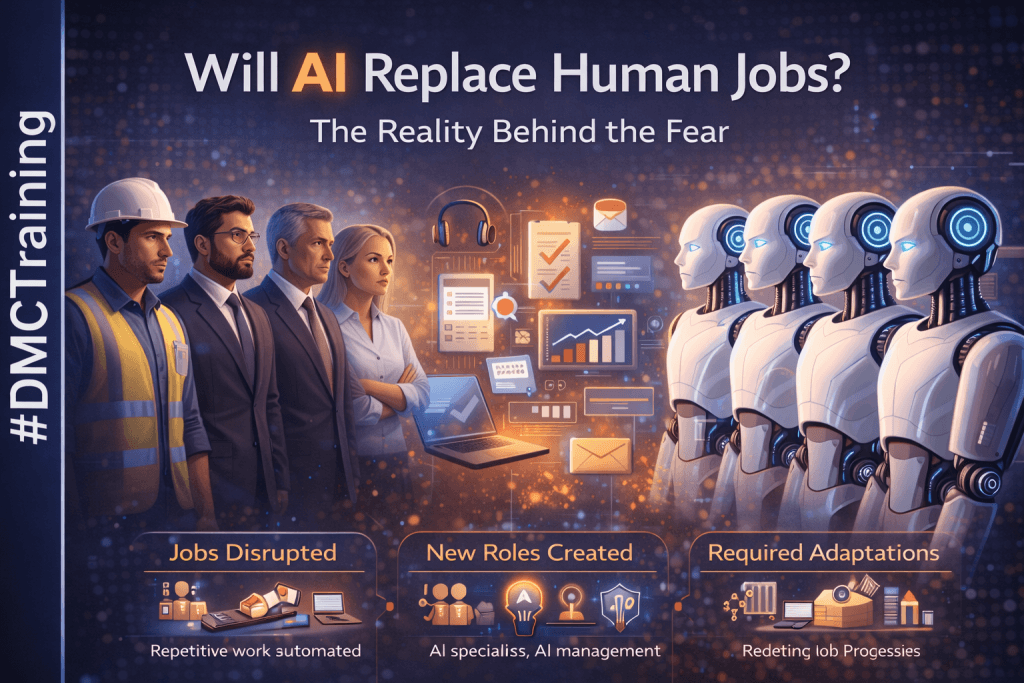
When people ask will AI replace human jobs, they are usually talking about employment displacement, not human extinction.
More specifically:
- Which roles are at risk?
- Which roles will evolve?
- Which roles will survive — or even grow?
Understanding this requires zooming out and examining both AI challenges and AI challenges in business.
Yes, AI Will Replace Some Jobs — That’s Not New
Let’s be clear:
Yes, AI will replace certain jobs.
This is not speculation — it’s already happening.
AI is most effective at replacing roles that are:
- Repetitive
- Predictable
- Rules-based
- High-volume
Common examples include:
- Data entry clerks
- Basic accounting roles
- Simple customer support agents
- Manual schedulers and dispatchers
This is what drives headlines about AI replace human jobs and fuels public fear.
But here’s the key distinction 👇
👉 AI replaces tasks, not entire careers.
Why Some Jobs Are More Vulnerable Than Others in the Age of AI
Jobs are most at risk when automation and ai systems can perform core tasks more efficiently; this affects how the labor market and workforce shift between 2025 and 2030.
- Human judgment adds little value and repetitive tasks can be automated by ai tools like generative ai or ai and machine learning
- Outcomes are easy to measure and optimise by ai algorithms, increasing productivity but reducing demand for human labor
- Context and emotion are minimal, so jobs that involve routine processing are more likely to be replaced by ai automation
AI thrives in environments where decisions can be optimised statistically; due to ai development and ai adoption, many jobs could be performed by ai systems or ai and robotics combined with new technology.
This explains many problems with AI perception — people assume artificial intelligence is “thinking,” when it’s actually pattern-matching at scale using ai algorithms to automate repetitive tasks and boost productivity.
These limitations are central to challenges in artificial intelligence and help explain the impact of artificial intelligence on specific sectors and the wider labor market.
Jobs That AI Is Least Likely to Replace
Despite rapid progress, many roles remain resistant to ai automation. The future of work will see ai creating new jobs even as many jobs are transformed by ai — the World Economic Forum and Goldman Sachs have estimated both lost to ai and million new roles may emerge.
Jobs that AI can’t replace (at least not fully) often involve human skills and require a human touch:
- Emotional intelligence and complex human interaction that ai is less likely to replicate
- Ethical decision-making, where ai tools like generative ai may assist but not decide
- Complex human interaction and negotiation that depend on empathy and context
- Creativity and original thinking that new ai can augment but seldom fully automate
Examples include roles that require a human touch and judgment:
- Managers and leaders who use ai tools to inform strategy but provide the human leadership ai won’t replace
- Teachers and educators who adapt curricula for ai literacy and help students navigate the age of ai
- Healthcare professionals where human interaction and ethical choices mean jobs will be transformed by ai rather than replaced
- Designers and strategists who combine ai tools like generative ai with original human creativity
- Negotiators and counsellors whose roles require emotional intelligence and cannot be fully automated
These roles will change — they won’t disappear. Implementing ai and adopting ai tools will create new roles and new jobs like ai system trainers, ai literacy educators, and hybrid positions that blend human skills with ai capabilities.
This is why the human vs AI debate is misleading. It’s not simply whether ai will replace human jobs; it’s how the workforce adapts, how employers use ai to boost productivity, and how the labor market creates new jobs and new roles between 2025 and 2030. Rather than asking “jobs will ai replace,” we should ask how ai will create opportunities, which jobs will be automated, and which require the human touch.
The Bigger Risk: Job Transformation, Not Job Loss
Here’s the truth most people miss when asking will AI replace human jobs:
Most jobs won’t disappear.
They will transform.
AI is changing:
- How work is done
- What skills are valuable
- How performance is measured
Employees who learn to work with AI become more productive and valuable.
Those who refuse adaptation face stagnation — not replacement.
This transformation is one of the most misunderstood AI challenges and opportunities.
How Businesses Are Reshaping Roles With AI
From a company perspective, AI challenges in business don’t revolve around mass layoffs.
They revolve around:
- Redesigning job scopes
- Upskilling the workforce
- Balancing automation with accountability
AI is increasingly used to:
- Assist analysis
- Support decision-making
- Automate low-value tasks
Businesses that rush to replace humans often face backlash, quality issues, and trust erosion.
Can AI Fully Replace Professional Judgment?
This is where fear peaks.
People ask:
Can AI replace human judgment?
The answer is nuanced.
AI can recommend decisions.
AI cannot accept responsibility for outcomes.
Judgment involves:
- Ethics
- Context
- Values
- Long-term consequences
These areas remain core challenges in artificial intelligence.
This is why organisations still need humans in:
- Final approvals
- Ethical decisions
- Strategic leadership
Replacing these roles would create more risk — not efficiency.
The Psychological Impact: Fear Is a Hidden Risk
Beyond economics, the question will AI replace human jobs also has psychological consequences.
Fear affects:
- Motivation
- Willingness to learn
- Trust in leadership
Poor communication around AI adoption becomes one of the quietest yet most damaging problems with AI.
This is why responsible organisations focus equally on change management, not just automation.
What History Teaches Us About Job Displacement
Every major technology shift sparked fear:
- Industrial machines
- Computers
- Internet automation
Jobs were lost — but new roles emerged.
AI follows the same pattern, but faster.
Those who adapt early gain leverage.
Those who wait face pressure.
This pattern highlights why asking what are the challenges of AI must include human readiness, not just technical capability.
So, Will AI Replace Human Jobs?
Here’s the honest answer:
👉 AI will replace certain roles
👉 AI will redefine many careers
👉 AI will not eliminate human relevance
The biggest risk isn’t AI.
It’s:
- Failing to upskill
- Ignoring role redesign
- Treating AI as a replacement instead of a tool
The Jobs That Survive Will Be More Human
The future of work favours humans who:
✅ Think critically
✅ Adapt quickly
✅ Use AI intelligently
✅ Make responsible decisions
AI doesn’t remove humans from work.
It removes low-value work from humans.
Those who embrace this shift will not be replaced.
They will be promoted by it.