

Human vs AI Comparison: Strengths, Limits, and Why Humans Still Matter
Few debates are as intense—or as misunderstood—as a clear human vs ai comparison when evaluating artificial intelligence and human intelligence together.
Some say advanced ai systems, generative ai, or a powerful ai model will replace human roles.
Others insist artificial and human intelligence differ so fundamentally that ai will never match human creativity or social intelligence.
Both views miss the practical point.
The core question isn’t simply ai vs human; it’s about where ai technologies and human abilities each excel, and where human intervention and emotional intelligence remain essential.
Understanding these differences and similarities helps guide responsible ai development, implementing ai applications, and deciding when to use ai tools versus relying on human decision-making.
What Does a Human vs AI Comparison Really Mean?
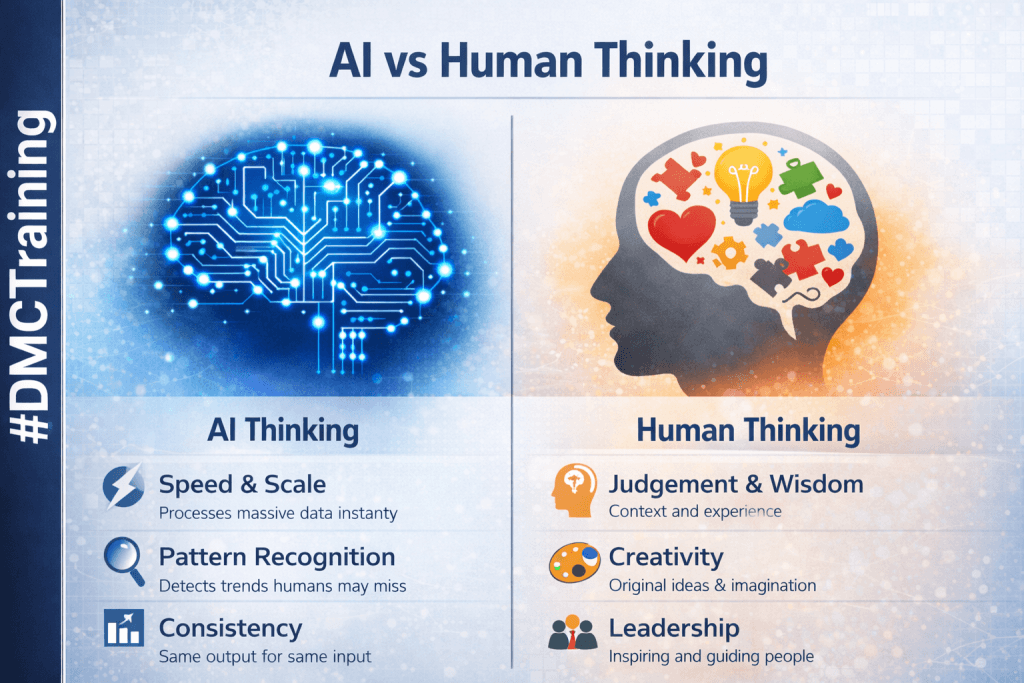
A thoughtful ai vs human intelligence comparison examines how ai and human intelligence differ across multiple dimensions:
- Forms of intelligence (human cognition, emotional intelligence, social intelligence)
- Human decision-making and accountability
- Creativity and human creativity versus generative ai output
- Ethics and responsible ai practices
- Human behavior and long-term judgment
- Practical ai applications and limitations of ai
This perspective clarifies why viewing ai as a tool—an ai system or ai model that learns and assists—often makes more sense than suggesting ai will replace humans entirely.
How AI Thinks vs How Humans Think
The foundation of ai and human intelligence discussions lies in how thinking happens in artificial intelligence systems compared to natural human cognition.
How AI “Thinks”
Ai tools and ai models:
- Analyse massive datasets to detect patterns
- Generate outputs probabilistically (generative ai can generate text, images, and more)
- Scale tasks across many domains using ai technologies and ai applications
But ai cannot truly understand meaning, intent, or moral consequence the way the human brain does; artificial intelligence systems excel at speed and scale, yet have clear limitations of ai that affect trust and accountability.
This gap is why augmented intelligence and ai as a tool are often proposed: use ai to enhance human capabilities and human skills rather than to replace human judgment.
How Humans Think
Humans and artificial intelligence differ because humans:
- Use context and lived experience
- Apply moral and ethical judgment in ambiguous situations
- Bring emotional intelligence, social intelligence, and creativity
- Reflect on long-term consequences and complex human behavior
Human intelligence isn’t only information processing; human cognitive flexibility, human language nuance, and the human brain’s pattern of thought mean humans and ai complement each other far more than they compete. Comparing ai to human intelligence highlights these key differences and opportunities for collaboration.
Key Differences and Similarities
Key differences between human and artificial intelligence include generalization (artificial general intelligence remains a research goal), accountability, and the ability to handle novel ethical dilemmas. Similarities appear when ai learns from data and models behavior that can mimic human responses.
Ai excels at repetitive, high-volume tasks, predictive analytics, and accelerating ai development in domains like artificial intelligence in healthcare, but ai replace humans is not a straightforward outcome—human intervention and human capabilities remain crucial for oversight, empathetic care, and complex decision-making.
Practical Guidance: When to Use AI and When to Rely on Humans
Use of ai and implementing ai should follow these principles:
- Apply ai applications and ai tools to automate routine analysis and augment human cognitive work
- Retain human oversight for decisions requiring ethics, empathy, or accountability
- Design responsible ai systems that are transparent and aligned with human values
- Leverage generative ai and ai models to boost productivity while validating outputs with human expertise
Augmented intelligence strategies focus on enhancing human abilities and human capabilities rather than eliminating the human role. In sectors like ai in healthcare, this means combining ai technologies with clinician judgment to improve outcomes without removing human empathy or responsibility.
Conclusion: Balancing Artificial and Human Intelligence
Comparing artificial intelligence and human intelligence reveals fundamental differences between natural and artificial thinking. The impact of ai will grow, and advanced ai and ai tools will change many workflows, but responsible ai, human creativity, and social intelligence ensure humans remain central.
Ultimately, viewing ai as a partner—an ai system that augments human cognition and human skills—captures the best path forward: use ai where it excels, rely on human abilities where nuance, morality, and empathy matter, and continue developing policies and technologies that recognize both the limitations of ai and the enduring strengths of human intelligence.
1. Speed and Scale: Where AI Dominates
In any human vs AI comparison, speed is AI’s strongest advantage.
AI can:
- Process millions of records in seconds
- Detect patterns beyond human capacity
- Work continuously without fatigue
This makes AI exceptional for:
- Data analysis
- Fraud detection
- Predictive modelling
Humans cannot compete on raw speed — and shouldn’t try.
2. Judgment and Wisdom: Where Humans Win
AI can recommend decisions.
But it cannot:
- Decide what should be done
- Weigh moral trade-offs
- Take responsibility for outcomes
Judgment requires values, ethics, and accountability — areas where humans remain essential.
This is one of the most important AI challenges in business: knowing when to stop automation and keep humans in control.
3. Creativity: Generation vs Meaning
AI can generate content:
- Text
- Images
- Music
But generation is not creativity.
In a true human vs AI comparison, creativity involves:
- Original perspective
- Cultural awareness
- Emotional expression
- Intentional storytelling
AI recombines patterns.
Humans create meaning.
This distinction explains why creative professions remain among the jobs that AI can’t replace.
4. Emotional Intelligence and Empathy
AI can simulate empathy through language.
But it does not:
- Feel emotion
- Experience suffering
- Understand human vulnerability
Empathy requires lived experience, trust, and shared understanding.
This limitation is one of the least discussed but most critical challenges in artificial intelligence — especially in education, healthcare, and leadership.
5. Learning and Adaptability
AI learns through:
- Training data
- Parameter optimisation
- Reinforcement feedback
Humans learn through:
- Experience
- Reflection
- Social interaction
- Moral reasoning
AI adapts within defined boundaries.
Humans adapt across unpredictable environments.
This distinction becomes crucial when discussing will AI replace humans — adaptability is not just intelligence, it’s survival.
6. Accountability and Responsibility
Here’s a question every organisation must answer:
When AI makes a mistake, who is responsible?
AI cannot:
- Be legally accountable
- Accept blame
- Repair trust
This is why leaders must remain in the loop.
In human vs AI comparison, accountability is a uniquely human burden — and privilege.
Removing it creates serious AI challenges and opportunities that many organisations are not prepared to manage.
7. Ethics and Values
AI does not possess ethics.
It reflects the values embedded in its data and training.
Humans:
- Debate right and wrong
- Adapt values over time
- Make exceptions when rules fail
Ethical reasoning is one of the deepest challenges in artificial intelligence — and the clearest reason humans cannot be removed from high-stakes decisions.
Why Human vs AI Is the Wrong Question
The biggest mistake in the human vs AI debate is framing it as a competition.
The real question is:
How should humans and AI work together?
AI is best at:
✅ Speed
✅ Pattern recognition
✅ Consistency
Humans are best at:
✅ Judgment
✅ Ethics
✅ Creativity
✅ Leadership
The strongest systems combine both.
Human–AI Collaboration: The Real Future
Successful organisations design workflows where:
- AI handles data-heavy tasks
- Humans make final decisions
- Oversight is continuous
This approach reduces problems with AI while maximising value.
It also addresses core AI challenges in business — trust, adoption, and accountability.
The Risk of Overvaluing AI
Overestimating AI capabilities creates new risks:
- Blind trust in outputs
- Removal of human checks
- Ethical failures
- Loss of customer trust
These risks explain why some organisations later ask:
What are the challenges of AI, and how did we miss them?
The answer is often misplaced confidence.
Why Humans Still Matter Most
So what does a true human vs AI comparison show us?
👉 AI is powerful — but not wise
👉 AI is fast — but not responsible
👉 AI is consistent — but not ethical
Humans remain irreplaceable where meaning, values, and accountability matter.
AI doesn’t replace humans.
It tests how well humans lead, design, and govern technology.
Those who understand this will thrive.
Those who don’t will struggle — not because of AI, but because of poor choices.