

Differences Between AI and Humans: What Technology Can’t Replicate
As artificial intelligence becomes more advanced, one question keeps resurfacing:
What really separates humans from machines?
Understanding the differences between AI and humans is no longer just academic. The differences between human cognition and machine computation shape regulation, workplace design, and the use of AI across industries.
Despite impressive progress, AI and humans are not the same kind of intelligence — and confusing the two creates serious AI challenges in business, ethics, and society. The field of artificial intelligence studies how artificial agents differ from natural minds and documents the fundamental differences between natural and artificial systems.
Let’s break down the differences clearly, without hype or fear, rather than viewing AI as merely a human-like replacement.
What Are the Differences Between AI and Humans?
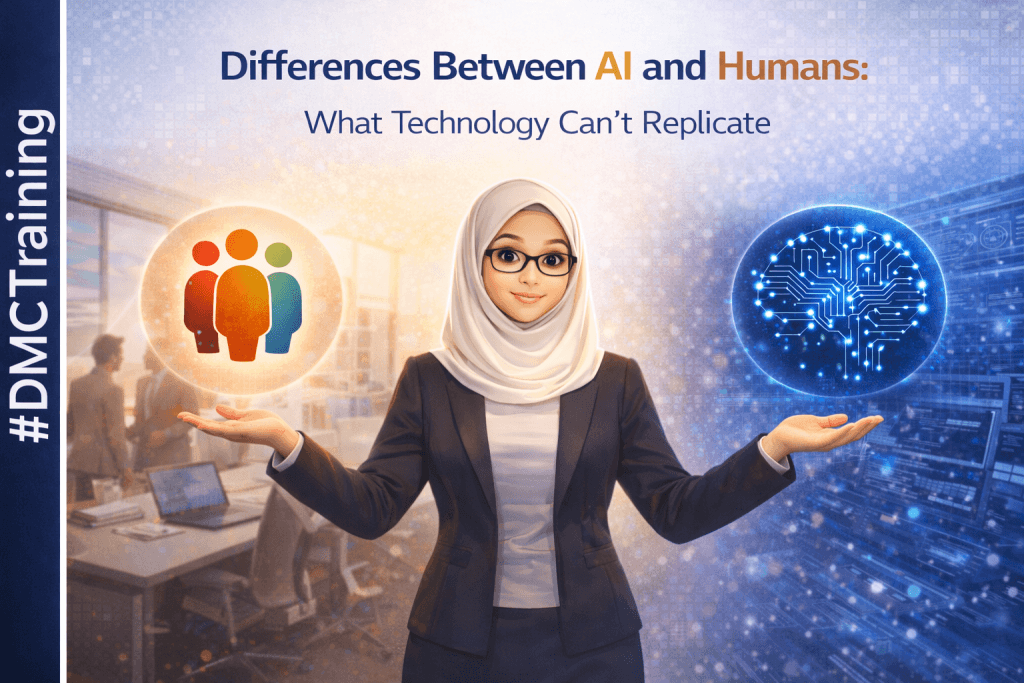
The differences between AI and humans lie in how intelligence, judgment, emotion, creativity, and responsibility are formed and expressed. Human intelligence and AI overlap in some capabilities, but human judgment often integrates values, context, and lived experience in ways that artificial intelligence cannot replicate.
AI and humans may both “solve problems,” but they do so in completely different ways. Multiple AI models can process vast datasets and spot patterns at scale; human intelligence is capable of abstraction, moral reasoning, and imaginative leaps that are unlike the pattern-driven outputs of many AI systems.
These differences explain:
- Why AI excels in tasks requiring speed, repetition, and large-scale pattern recognition — AI excels in tasks requiring raw computation and data handling.
- Why humans remain irreplaceable in roles needing empathy, ethical judgment, and contextual creativity — unlike humans, AI lacks lived experience and true understanding.
- Why human vs AI is not a fair comparison: we should contrast human intelligence and AI by examining what each is expected to do and where complementary collaboration is better than substitution.
Rather than viewing AI as a replica of human thought, consider how humans and AI systems can combine strengths. AI has already transformed many industries and is increasingly present in everyday tools, but its capabilities of AI remain grounded in data, algorithms, and design choices made by humans.
Fundamental human traits — moral intuition, self-awareness, and social bonding — differ from machine processes. Intelligence may be characterized by adaptability in humans and by optimization in machines; intelligence is capable of learning in both domains, but the mechanisms differ from biologically rooted cognition to engineered architectures.
In practical terms, the use of AI should be framed as augmenting human work rather than replacing the nuanced responsibilities that require human oversight. Without human context, AI-driven decisions risk missing fairness, purpose, and long-term implications.
When comparing the fundamental differences between natural and artificial systems, remember that ai with human intelligence remains a research aspiration, not a current reality. The view of AI as like a human thinker oversimplifies the situation; the field of artificial intelligence documents how differently machines and humans solve meaning, intent, and value.
1. Intelligence Type: Statistical vs Experiential
AI Intelligence
AI operates using:
- Algorithms
- Mathematical models
- Probabilistic predictions
It identifies patterns from past data and outputs the most likely result.
AI does not understand meaning — it calculates likelihood.
This limitation is central to many challenges in artificial intelligence.
Human Intelligence
Humans rely on:
- Experience
- Context
- Intuition
- Reflection
Humans understand why something matters, not just what is likely.
This is the first and most fundamental difference.
2. Consciousness and Self-Awareness
AI has no awareness of itself.
It does not:
- Experience thoughts
- Feel emotions
- Understand existence
Humans possess consciousness — the ability to reflect, feel, and be self-aware.
This is why asking can AI replace human consciousness is a misunderstanding.
AI simulates behaviour — humans experience reality.
3. Emotional Intelligence and Empathy
AI can analyse sentiment and generate empathetic language.
But it does not actually feel empathy.
Humans:
- Experience joy, fear, guilt, and compassion
- Respond emotionally to others
- Build trust through shared understanding
This gap explains why roles involving care, leadership, and education remain among the jobs that AI can’t replace.
It’s also one of the most underestimated problems with AI adoption.
4. Creativity and Original Thought
AI systems and ai applications can generate a wide range of outputs, but their process differs from human creativity.
- Images produced by ai models
- Text generated by generative ai
- Music composed with ai tools
However, generation is not the same as originality: artificial intelligence and human intelligence approach creativity differently.
An ai system creates by remixing existing patterns learned from training data and ai development, while human intellect often introduces novel context.
Humans create by:
- Expressing lived experience and social intelligence
- Challenging norms through moral reflection and human decision-making
- Producing meaning with intent, drawing on human cognition and forms of intelligence
This distinction is one of the key differences in artificial intelligence vs human intelligence debates, highlighting how human and artificial intelligence differ from each other.
AI tools and ai applications assist creativity and can enhance human abilities, but humans define purpose and meaning.
5. Learning and Adaptation
An ai system learns through algorithmic processes:
- Training data used by ai models
- Feedback loops in ai development and deployment
- Parameter optimisation within artificial intelligence systems
Such systems improve within a defined system and narrow ai constraints, which illustrates limitations of ai in general.
Humans learn through broader channels:
- Experience that shapes human cognition
- Failure that informs human decision-making and adaptation
- Social interaction that develops social intelligence and human language skills
- Moral reflection that engages human intellect and values
Humans can adapt to completely new, undefined situations in ways that differ from ai applications and ai models, showing how human cognitive abilities remain distinct.
This adaptability is one of the hardest challenges in artificial intelligence to overcome, and it shapes conversations about responsible ai, collaboration between humans and technology, and the impact of ai on human capabilities and the use of artificial intelligence in domains such as artificial intelligence in healthcare and other ai in healthcare deployments.
6. Ethics and Moral Reasoning
AI does not have values.
It reflects the values embedded in:
- Training data
- Design choices
- Developer intent
Humans can:
- Debate ethics
- Change moral perspective
- Make exceptions when rules fail
This explains why ethics remain a human responsibility — and why removing people from high-impact decisions creates severe AI challenges in business.
7. Accountability and Responsibility
When humans make a decision, responsibility is clear.
When AI makes a decision, accountability becomes complex.
AI cannot:
- Accept blame
- Correct moral failure
- Repair trust
This difference is why humans must remain involved in:
- Hiring decisions
- Financial approvals
- Legal judgments
- Strategic leadership
Ignoring this leads to some of the most damaging AI challenges and opportunities in modern organisations.
8. Speed vs Wisdom
AI excels at speed:
- Rapid analysis
- Large-scale processing
- Consistent execution
Humans excel at wisdom:
- Long-term thinking
- Ethical trade-offs
- Value-based decisions
Speed without wisdom magnifies error.
Wisdom without speed limits scale.
This is why successful systems combine both.
Why Confusing These Differences Creates Risk
Many problems with AI begin when organisations assume:
- AI understands like humans
- AI can replace judgment
- AI should decide autonomously
These assumptions lead to:
- Ethical failures
- Loss of trust
- Poor decision quality
Understanding the differences between AI and humans is not about limiting innovation — it’s about protecting it.
Human–AI Collaboration: The Practical Future
Instead of asking will AI replace humans or framing everything as ai vs human intelligence, a better question is:
How do we design systems where humans and AI complement each other, leveraging augmented intelligence so that ai and human intelligence work together rather than compete?
In effective collaboration:
✅ AI handles data, repetition, and multiple ai-driven processes like pattern detection and automation that ai automates
✅ Humans handle judgment, values, creativity, and context where human intelligence brings creativity and human cognitive capacities matter
✅ Oversight is continuous, with human intervention to manage limitations of ai vs human intelligence
This approach reduces AI challenges while maximising benefits from ai technologies, implementing ai thoughtfully and deploying ai where it augments human skills.
Technology Advances, Humanity Decides
So what do the differences between AI and humans and the differences between artificial intelligence and natural intelligence ultimately teach us about the science of ai and the human brain?
👉 AI is powerful but not conscious — artificial and human intelligence differ: intelligence and ai are related but fundamentally different from human intelligence processes and human cognitive capacities
👉 AI is fast but not wise — ai learns and can generate human language, yet it lacks the moral reasoning and holistic judgment that human agents and human doctors bring
👉 AI is consistent but not ethical — trust in ai depends on transparency, oversight, and understanding how ai may influence human decisions
Humans are not being replaced; human intelligence isn’t obsolete.
They are being challenged to lead more thoughtfully, to decide when to deploy ai and when human intervention is required, blending human-like intelligence with the capacities of ai.
The future does not belong to machines alone. It belongs to humans who understand the differences and similarities between natural and artificial systems, who know how to use ai, who build trust in ai, and who guide successful ai in relation to human values — ensuring that ai research and implementing ai support human skills and augment rather than replace human expertise in everyday life.