

Will AI Replace Humans? The Truth Most People Don’t Want to Admit
Few questions trigger more fear, debate, and clickbait headlines than this one:
Will AI replace humans?
Some say yes — completely.
Others say never.
The real answer?
More uncomfortable, more nuanced, and far more important.
AI is not here to “replace everyone.”
But it is reshaping how humans work, think, and create value — and pretending otherwise is one of the biggest AI challenges of our time.
Let’s break this down honestly.
What Does “Will AI Replace Humans” Actually Mean?
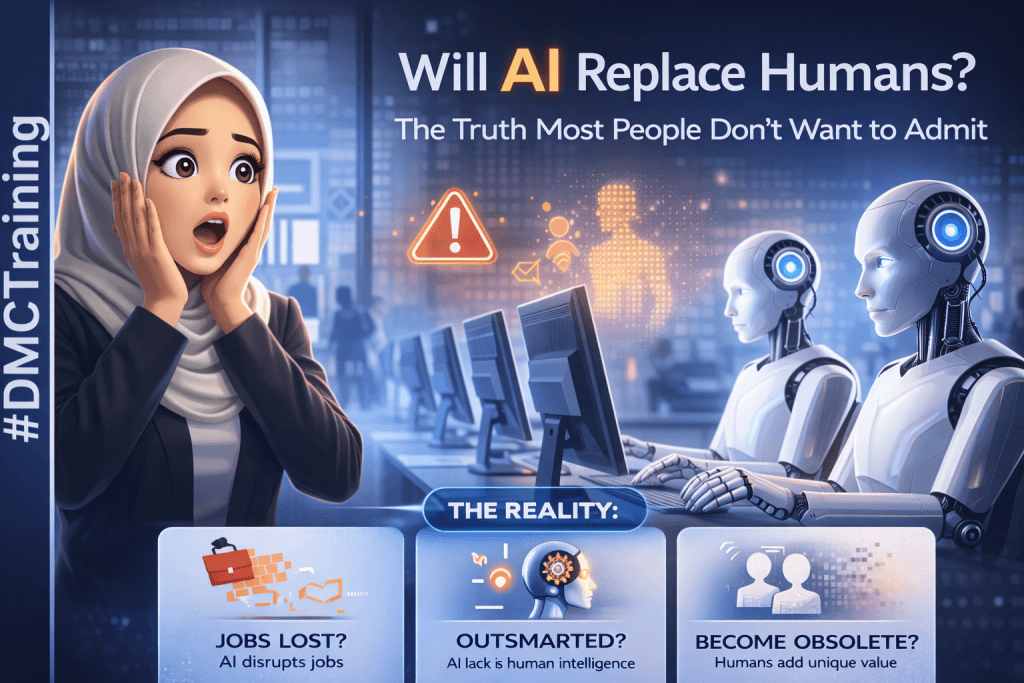
When people ask will AI replace humans or worry that ai will replace human roles, they usually mean one of three related things about artificial intelligence, ai systems and the future of ai.
- Will AI replace human jobs — will automation and ai replacing people lead to mass unemployment or millions of jobs lost?
- Will AI outperform human intelligence — will ai and machine learning or generative ai surpass human intelligence and emotional intelligence?
- Will humans become irrelevant because ai can process vast amounts of data and identify patterns that change the way we work and human relationships?
Each question points to different issues — the economics of ai, ai development and the impact of artificial intelligence — and confusing them is one of the biggest problems with AI conversations today. Experts from Geoffrey Hinton to Bernard Marr, and tech giants including OpenAI, NVIDIA CEO Jensen Huang, and voices like Bill Gates and Elon Musk, have weighed in on what new ai means for human work.
1. Will AI Replace Human Jobs?
Yes — some jobs will be replaced, but the picture is mixed: ai won’t replace humans entirely and ai will create new jobs and new roles even as it automates routine tasks.
This is not a simple “robots takeover” narrative. The ai revolution and generative ai are powerful tools that change the way we work by automating repetitive tasks and augmenting human labor.
AI primarily replaces:
- Repetitive and rules-based tasks
- High-volume administrative work and repetitive tasks like data entry
- Certain simple analysis that ai can process vast amounts of data to complete
This is why automation and ai systems are strongest in areas such as:
- Data entry and routine tasks
- Basic customer support using ai tools like chatgpt and other ai-powered assistants
- Scheduling, routing, and simple logistics
- Preliminary analysis where machine learning models can predict outcomes and identify patterns
Headlines about mass unemployment or millions of jobs disappearing ignore that ai is a technology that also creates new jobs: new roles in ai development, cybersecurity, data science, ai-powered product design and related jobs will emerge as part of the ai era.
But here’s the important part 👇
AI replaces tasks, not entire humans. While some white-collar and blue-collar roles will change, humans may shift into higher-value, creative, supervisory and interpersonal roles that require human emotional intelligence and understanding of human contexts — things ai cannot fully replicate.
2. Why Will AI Replace Humans Is the Wrong Question
Although machine intelligence and automation have advanced quickly, they face fundamental limits that prevent full substitution of people.
AI lacks several human capacities:
- Conscious understanding and awareness
- Emotional cognition and genuine emotional intelligence
- Ethical judgment and moral reasoning
- Deep contextual understanding and nuanced situational judgment
These weaknesses are central to ongoing challenges in artificial intelligence, including robustness, explainability, and trustworthy AI.
While AI excels at pattern recognition, statistical inference, and narrow task automation, it does not grasp meaning or intent in the rich, embodied way humans do.
For that reason, roles that require:
- Leadership and people management
- Original creativity and artistic innovation
- Strategic thinking, long-term planning, and judgment under uncertainty
- Caregiving, therapy, and other human-centered services
Remain hard to fully automate and unlikely to be wholly replaced by machines.
So when asking “will AI replace humans” or “can AI replace human” roles entirely, the practical answer is that full replacement is improbable; instead expect augmentation, task shifting, and new hybrid roles.
👉 Not realistically — and not sustainably. Focus instead on human–AI collaboration, reskilling, and policies that address workforce transitions.
3. Human vs AI: A False Competition
The debate is often framed as human vs AI.
That framing is misleading.
AI excels at:
- Speed
- Consistency
- Large-scale data processing
Humans excel at:
- Judgment
- Empathy
- Creativity
- Ethics
When viewed correctly, AI is not a replacement — it is an amplifier.
This is why the most successful organisations don’t ask:
Will AI replace humans?
They ask:
How can humans work with AI?
4. Jobs That AI Can’t Replace (And Why)
Certain roles resist automation because they rely on uniquely human traits.
Examples of jobs that AI can’t replace include:
- Therapists and counsellors
- Teachers and educators
- Leaders and executives
- Designers and creative directors
- Negotiators and mediators
These roles depend on trust, emotion, values, and situational judgment — areas where AI currently struggles.
This doesn’t mean these jobs won’t change.
It means humans remain essential.
5. The Real Risk: Humans Replacing Humans With AI
Here’s the uncomfortable truth most articles avoid:
The biggest threat isn’t AI replacing humans.
It’s humans replacing humans with AI incorrectly.
This happens when:
- AI decisions are trusted blindly
- Human oversight is removed too early
- Speed is prioritised over wisdom
This creates new AI challenges in business:
- Customer dissatisfaction
- Ethical failures
- Loss of trust
AI used without responsibility doesn’t eliminate human error — it scales it.
6. Will AI Replace Humans Creatively?
This is one of the fastest-growing fears.
AI can:
- Write text
- Generate images
- Compose music
But here’s the crucial distinction:
AI remixes creativity.
Humans originate meaning.
AI does not:
- Hold lived experience
- Feel purpose or emotion
- Understand cultural nuance deeply
This is one of the most misunderstood challenges in artificial intelligence.
Creative professionals aren’t being replaced — they’re being reshaped.
7. Psychological and Social Impact: A Hidden Challenge
Beyond jobs, asking will AI replace humans also carries a psychological dimension.
People fear:
- Loss of identity
- Loss of purpose
- Loss of relevance
This fear is real — and ignoring it creates long-term social damage.
This is why AI challenges and opportunities must be discussed responsibly, not sensationally.
8. The Future: Augmentation, Not Replacement
The future is not AI instead of humans.
It is:
- Humans + AI
- Judgment + automation
- Ethics + efficiency
Organisations that understand this reduce problems with AI dramatically.
They:
✅ Keep humans in the decision loop
✅ Use AI as a support tool
✅ Redesign roles instead of removing them
This is how AI becomes a productivity partner — not a threat.
So… Will AI Replace Humans?
Here’s the honest answer:
👉 AI will replace some tasks
👉 AI will reshape many jobs
👉 AI will not replace human purpose, judgment, or responsibility
The real danger is not AI.
It is misunderstanding:
- What are the challenges of AI?
- Where does AI add value?
- Where must humans remain in control?
AI Tests Humanity, Not Humanity’s Replaceability
The question will AI replace humans reveals something deeper.
It’s not really about machines.
It’s about how humans:
- Design systems
- Make decisions
- Value people
AI doesn’t ask to replace us.
It forces us to decide what it means to be human at work.
Those who adapt will thrive.
Those who abdicate responsibility will suffer.