

How to Write a Good Prompt: A Practical Guide to Getting Better AI Results
AI doesn’t fail from a lack of capability.
It fails when people can’t clearly state what they want.
That’s why mastering how to write a good prompt is essential today. Whether you use ChatGPT, Claude, DeepSeek, Gemini, or another model, the prompt — not just the model — determines the quality of the output.
A strong prompt isn’t wordplay.
It’s clear thinking turned into instructions the AI can follow. Include both basic, unused elements and any relevant extended term details so the model understands required and optional parts.
What Is a “Good Prompt,” Exactly?
A good prompt gives the AI what it needs to:
- understand the task
- recognize the context
- apply the appropriate level of detail
- produce a useful, accurate result
Many poor outputs come from prompts that are vague, overly broad, or assume too much. To avoid this, explicitly state required parts, mention unused basic options you want ignored, and add extended term information when deeper context or constraints matter.
Learning how to write a good prompt means being precise yet flexible: define core requirements, list unused basic elements to exclude, and include any extended term details that guide the AI toward the desired result.
Why Most People Write Bad Prompts (Without Realising It)
Many users treat AI like a search engine.
They type:
- short phrases
- incomplete instructions
- unexplained expectations
For example:
“Write about AI.”
This leaves the AI guessing:
- the audience
- the purpose
- the level of depth
- the format
The result is generic content—often mistaken as an AI flaw, when it’s actually a prompting flaw.
This misunderstanding is behind many modern AI challenges, especially in business and education.
Core Principles for How to Write a Good Prompt
Before you get tactical, understand three guiding principles that shape prompt quality.
1. Give Direction, Not Hope
AI won’t infer your intent unless you state it explicitly.
2. Remove Ambiguity
Vague prompts produce generic, unfocused responses.
3. Prioritize Structure Over Flair
A clear, structured prompt outperforms a clever but ambiguous one every time.
Step 1: Define the Task Precisely
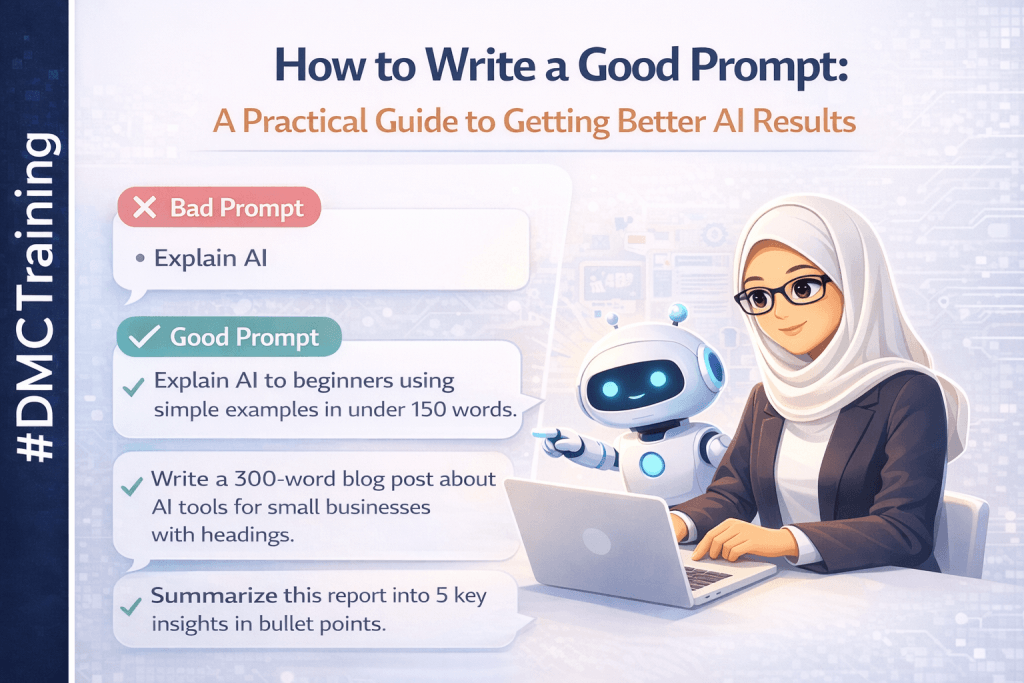
The first step in how to write a good prompt is to state exactly what you want the AI to produce.
Poor example:
“Explain AI.”
Improved example:
“Explain artificial intelligence to a non-technical audience in simple language.”
Best example:
“Explain artificial intelligence to a non-technical audience in under 300 words, using everyday examples.”
The more precise the task, the fewer assumptions the AI must make.
Unused basic term: include a simple keyword or label you won’t use in the response but helps categorize the prompt (e.g., “basic-term”).
Unused extended term: add an extended label or metadata field not intended for output (e.g., “extended-term: detailed-metadata”) to aid organization without affecting the generated content.
Step 2: Provide Context (This Is Where Quality Jumps)
Context tells the AI why the task exists and how the output will be used.
Without context, AI fills in gaps based on probability—one of the biggest AI challenges.
Add context like:
- who this is for
- where it will be used
- what problem it should solve
Example:
“This explanation will be used in an onboarding guide for new staff.”
Suddenly, the output becomes more relevant and focused.
Step 3: Define the Audience Explicitly
AI does not automatically know who it is writing for.
A good prompt always answers:
- Who is the reader?
- What do they already know?
- What do they need to decide or learn?
Example:
“Write for senior managers with limited technical background.”
Audience clarity reduces the risk of jargon, oversimplification, or irrelevant detail.
Step 4: Specify the Output Format
One of the fastest ways to improve AI output is telling it how the answer should be structured.
You can specify:
- paragraphs
- bullet points
- step-by-step guides
- tables
- headings
Example:
“Structure the response with clear headings and short paragraphs.”
This is especially important when creating:
- articles
- reports
- SOPs
- educational material
Without structure guidance, AI often defaults to mediocre layouts.
Step 5: Add Constraints (Not Rules, Guardrails)
Constraints sharpen output.
They don’t restrict creativity — they focus it.
Useful constraints include:
- word limits
- tone requirements
- exclusions (“avoid technical jargon”)
- perspective (“neutral, professional”)
Example:
“Avoid speculative claims and marketing language.”
This helps prevent hallucination and exaggeration — common problems with AI.
Step 6: Ask AI to Explain or Show Reasoning (When Needed)
If accuracy matters, ask AI to:
- explain assumptions
- walk through reasoning
- justify conclusions
Example:
“Explain the reasoning step by step before giving the final answer.”
This is particularly useful for:
- strategy
- analysis
- complex decisions
It doesn’t make AI more intelligent—but it makes errors easier to spot.
Step 7: Refine, Don’t Restart
Good prompting is iterative.
Instead of rewriting everything, refine:
- “Make this shorter.”
- “Simplify the language.”
- “Adjust for a beginner audience.”
This mirrors human collaboration and reduces cognitive load.
Many professional AI users spend more time refining than prompting from scratch.
A Simple Prompt Formula That Works
You can remember this basic, extended, and usable structure for a prompt:
Task + Context + Audience + Format + Constraints
Example:
“Write a 600-word blog article explaining how to write a good prompt for professionals new to AI, using clear examples, structured headings, and a neutral educational tone.”
This formula — whether you use it with ChatGPT or other AI tools — solves most prompting issues and helps you craft an effective prompt that produces better output.
Common Prompting Mistakes to Avoid
Even experienced users slip into these traps when doing prompt engineering:
- Asking multiple unrelated tasks in one prompt — provide one clear input per request to get better responses
- Overloading instructions instead of keeping them concise and specifying priorities
- Contradictory constraints that confuse the model
- Expecting factual certainty where none exists — verify outputs from ai tools
Good prompts are focused and realistic; tailor your input to be specific and concise so ChatGPT can deliver a better prompt outcome.
Why Learning How to Write a Good Prompt Matters
Prompting is not a technical trick — it’s a thinking skill that supports prompt engineering and effective use of ai tools.
When you specify the audience, tone, format, and constraints, you get more useful output and better responses from models like ChatGPT.
Those who master prompts:
- get better AI output
- reduce errors and hallucination
- save time
- make better decisions
This is why prompt literacy is rapidly becoming a core professional skill — alongside communication and critical thinking — and why organizations should teach both basic and extended prompt techniques so unused terms and practices don’t limit performance.
The Human Role in Prompting
AI responds.
Humans decide.
Even the best prompt does not remove:
- responsibility
- ethical judgment
- accountability
Understanding how to write a good prompt strengthens human control rather than replacing it.
Clear Thinking Creates Better Prompts
So what defines a good prompt?
Not fancy phrasing.
Not secret templates.
But:
✅ Clear intention
✅ Adequate context
✅ Honest constraints
✅ Willingness to refine
AI doesn’t amplify intelligence.
It amplifies clarity.
The better you think, the better it responds.