

What Are AI Prompts & How They Work
Artificial intelligence doesn’t “think” the way humans do.
It doesn’t understand intention, emotion, or meaning on its own.
Everything an AI produces — answers, images, code, summaries — begins with one thing:
the prompt.
This is why understanding what AI prompts are and how they work has become one of the most important skills in the age of artificial intelligence. Whether you’re using ChatGPT, Claude, DeepSeek, Gemini, or any other AI system, the quality of your results is determined less by the model itself — and more by how well you communicate with it.
What Are AI Prompts?
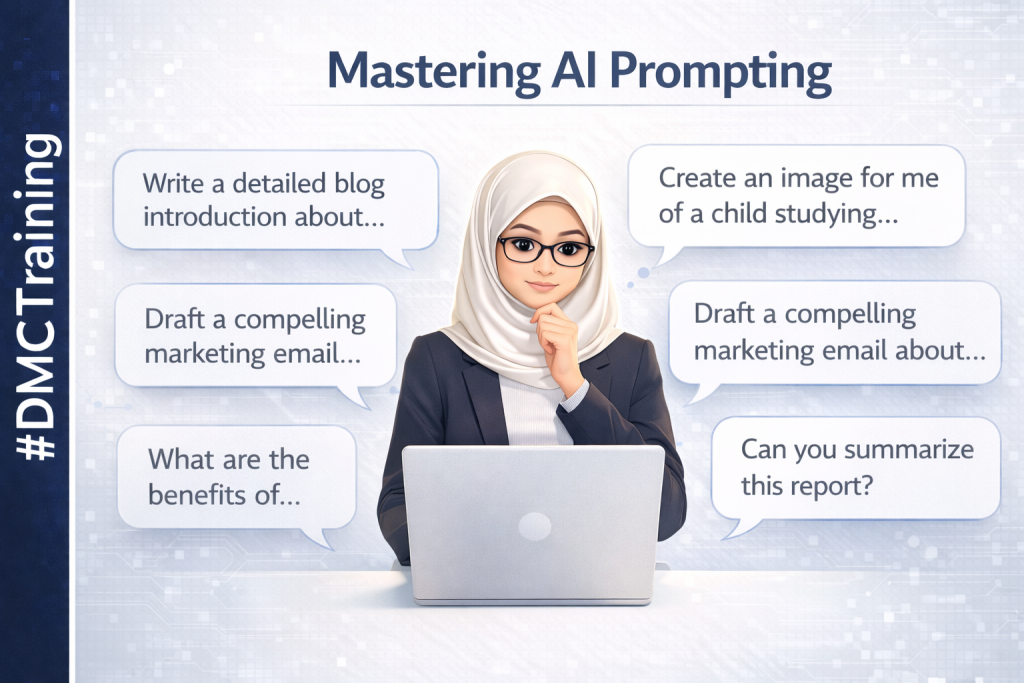
AI prompts are the instruction, query, or input you give to an artificial intelligence or generative AI model to specify the desired output. In practice a prompt is the input that helps the AI generate a response, whether you use a chatbot like ChatGPT or other generative ai tools.
In simple terms:
- A prompt tells the AI what to do — the task or goal you want the ai to achieve
- How to do it — the format, tone, constraints or structure
- And sometimes what rules to follow, a knowledge base to use, or the assumed context
A prompt can be as simple as a single sentence or a well-crafted, extended brief used in prompt engineering and writing effective ai prompts. For example:
- “Summarise this article” — a concise first prompt or query to get a summary
- “Write a professional email” — specify audience, tone, and desired outcomes
- “Explain this concept to a beginner” — tailor the explanation using natural language
- “Generate a lesson plan with examples and exercises” — prompt to guide AI to produce structured outputs
AI does not decide goals on its own; it responds to prompts — and only prompts. Effective prompts and prompt engineering help harness the full potential of generative ai models and reduce ai hallucination by providing clear, accurate instructions.
Why AI Prompts Matter More Than the AI Tool Itself
Many people assume that better ai models automatically produce better results. That’s only half true. The quality of outputs from generative ai tools depends heavily on writing effective prompts and asking the model the right prompt.
Two people can use the same ai tool like ChatGPT and get wildly different outcomes depending on how they craft prompts.
This is why prompts are central to many modern applications of ai and to prompt engineering best practices. A well-crafted prompt provides context, examples, and constraints that help the ai to generate more useful, accurate and relevant outputs by leveraging the patterns it has learned.
A weak prompt leads to:
- Generic answers that don’t meet the desired output
- Incorrect assumptions or confusion that can confuse the model
- Shallow or misleading responses and possible ai-generated content errors
A well-designed prompt leads to:
- Clear reasoning and structured outputs
- Relevant structure and concise, useful responses
- More accurate and useful outputs that match your desired outcomes
This is often called the “garbage in, garbage out” principle — not because artificial intelligence is bad, but because generative ai mirrors the clarity of the input it receives. Learning prompt examples, writing ai prompts, and following best practices in prompt engineering is the beginner’s guide to crafting effective prompts and using ai to generate the right outputs for use cases like generating images, writing samples, or building a knowledge base. Good prompts break down complex queries, ask the ai to assume roles when helpful, and provide the model with instructions or questions that help produce accurate and relevant outputs — like having a conversation that guides the ai to produce better results.
How AI Prompts Work Behind the Scenes
To understand how AI prompts work, it helps to understand how AI models generate responses.
Large language models (LLMs) such as ChatGPT, Claude, or DeepSeek operate by predicting the most likely next word based on:
- The prompt
- Their training data
- The conversational context
They do not retrieve “answers” from a database.
They generate responses statistically, based on patterns learned from enormous datasets.
This means:
- The AI does not know facts the way humans do
- It predicts responses that look correct given the prompt
That’s why prompts matter so much.
They shape the context in which the AI makes predictions.
The Role of Context in AI Prompts
Context is the invisible force behind good prompting.
When you provide context, you reduce ambiguity and guide the AI toward the outcome you want. Without context, the AI fills in gaps — sometimes incorrectly.
For example:
- “Write a summary” → vague, generic result
- “Write a 200-word executive summary for a marketing manager” → focused, relevant result
This is also why prompts are deeply connected to challenges in artificial intelligence like hallucination and inconsistency. Poor context invites the AI to assume things that may not be true.
Types of AI Prompts
AI prompts generally fall into several categories, depending on intent.
Informational Prompts
These ask the AI to explain or describe something.
- “Explain artificial intelligence in simple terms”
- “What is machine learning?”
Instructional Prompts
These tell the AI to perform a task.
- “Write an email”
- “Create a lesson plan”
- “Generate a table”
Role-Based Prompts
These assign a persona or role to guide tone and perspective.
- “Act as a marketing consultant”
- “You are a financial analyst”
Constraint-Based Prompts
These set boundaries and rules.
- “Use simple language”
- “Limit to 300 words”
- “Avoid technical terms”
Most high-quality outputs use a combination of these prompt types.
Why Poor Prompting Causes AI Errors
Many of the so-called problems with AI are actually problems with prompting.
Common prompt mistakes include:
- Being too vague
- Asking multiple unrelated things at once
- Not specifying the audience or format
- Assuming the AI has missing information
When this happens, users often blame the AI itself.
In reality, the AI responded exactly as instructed — just within an unclear framework.
This misunderstanding plays a major role in AI challenges in business, where AI outputs may influence decisions, content, or customer interactions.
AI Prompts vs Prompt Engineering
You may hear the term “prompt engineering.”
Prompt engineering is simply the practice of:
- Structuring prompts carefully
- Using iteration and refinement
- Testing variations to improve output quality
Despite the intimidating name, prompt engineering is not coding.
It is communication strategy.
Learning how prompts work doesn’t require a technical background — but it does require clarity of thinking.
How AI Prompts Affect Bias and Accuracy
AI models reflect patterns in their training data. Prompts influence which patterns are activated.
This is why prompts can:
- Reduce bias (with clear constraints)
- Increase bias (through careless framing)
- Improve factual grounding (by requesting sources or logic)
- Increase hallucination (by encouraging speculation)
This makes prompting a key factor in managing AI challenges and opportunities responsibly.
Why Prompts Are Central to Human–AI Collaboration
The idea that AI will fully replace humans ignores a simple truth:
AI systems still rely on human instruction.
Prompts are the interface between human intention and machine output. They determine whether AI:
- Supports human judgment
- Or undermines it
This is why prompts are not just technical tools — they are decision-making tools.
Well-structured prompts enhance productivity.
Poor prompts amplify mistakes.
Practical Example: Same AI, Different Prompts
Prompt A:
“Write about AI prompts.”
Prompt B:
“Write a 1,000-word educational article explaining what AI prompts are, how they work, and why they matter for professionals, using clear examples and a neutral tone.”
Same AI.
Completely different output quality.
This illustrates why AI capability alone doesn’t solve AI challenges — usage does.
Prompts Are the Real Skill
So, what are AI prompts and how do they work in practice?
They work by translating human intention into structured signals that AI can interpret. They shape accuracy, relevance, tone, and usefulness more than most people realise.
AI is powerful — but it is not intuitive.
The more clearly you think, the better AI responds.
In the age of artificial intelligence, prompting is not a technical trick.
It is a core literacy skill.
Those who master prompts don’t just use AI better.
They lead the interaction.