

AI Adoption Issues & Risks: What Organisations Must Prepare for Before Implementing AI
Adopting Artificial Intelligence sounds like progress.
But for many organisations, AI adoption turns into confusion, resistance, and wasted investment — not innovation.
Why?
Because AI doesn’t fail quietly.
It exposes weaknesses in strategy, data, culture, and governance.
Understanding AI adoption issues & risks before implementation is not pessimism — it’s responsible leadership.
This article explains the real risks organisations face, why AI adoption often struggles, and how to manage these challenges intelligently.
What Are AI Adoption Issues & Risks?
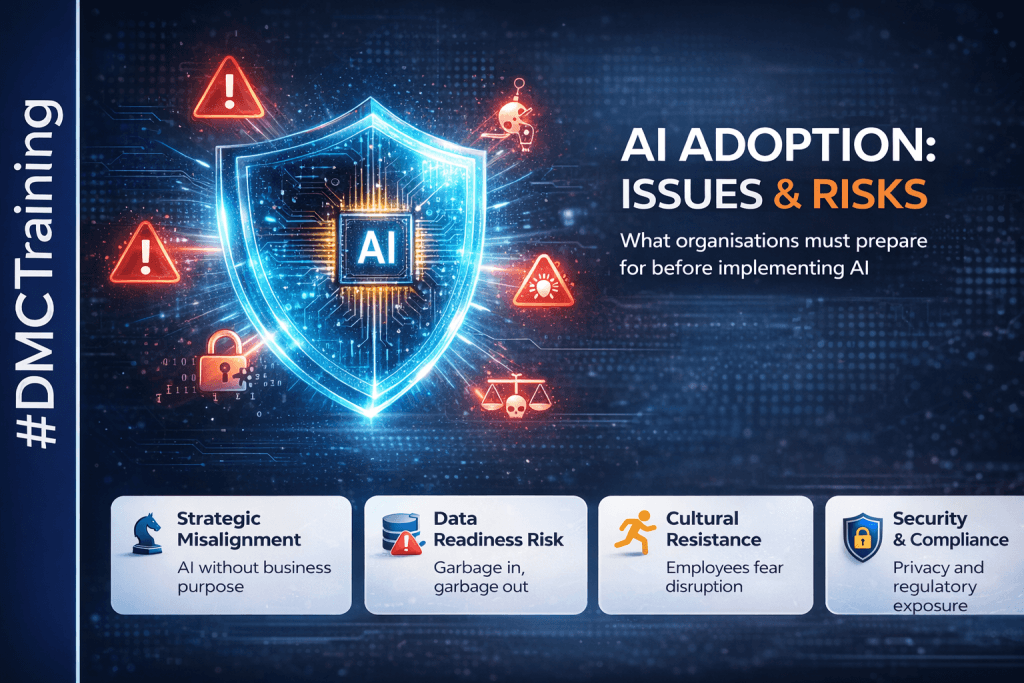
AI adoption issues & risks describe the strategic, technical, regulatory and ethical problems organisations face as they move along the ai journey and attempt ai integration of ai technologies, ai models and ai applications into business process and legacy systems.
These risks often overlap with common challenges to ai adoption and include:
- adoption challenges
- privacy concerns and data privacy
- ethical concerns and ai ethics
- technical challenges and ai infrastructure
Timing matters: some issues surface during planning while others appear after deployment of ai or gen ai into workflows.
Adoption issues and the risks associated with ai appear before and during implementation, when stakeholders underestimate the scale of change required and treat new technology as a plugin rather than a transformation of business process.
1. Strategic Misalignment: Adopting AI Without Purpose
One of the biggest ai adoption challenges and a significant challenge to ai success is deploying ai models or ai solutions without a clear ai strategy and measurable key performance indicators tied to business outcomes.
Many organisations chase ai because:
- Competitors are experimenting with ai platforms and agentic ai
- Leadership feels innovation pressure during the ai revolution
- Vendors and ai vendors promise rapid ROI and transformative potential
Without alignment to business goals, generative ai or other ai applications become disconnected from real needs and the return on investment evaporates.
This creates familiar problems with ai:
- Pilot projects that never scale into production ai workloads
- ai platforms and tools that don’t address core pain points
- Teams lacking ai expertise and clear ownership by stakeholder groups
Risk multiplies when the organization lets new ai be technology-led instead of strategy-led; a governance framework and ai principles are needed to ensure ai is developed and used responsibly.
2. Data Readiness Risk: Garbage In, Garbage Out
Successful ai adoption requires high-quality data, robust ai infrastructure, and thoughtful feeding information into ai models and ai algorithms.
One of the most severe risks associated with ai is assuming existing records are ready for ai development or gen ai — a classic data readiness failure that can undermine ai implementation.
In practice, organisations struggle with:
- Fragmented databases and disconnected legacy systems
- Inconsistent data definitions that break ai algorithms
- Historical bias embedded in records that lead to unfair outputs
- Missing, unstructured or poorly labelled information for training programs
Poor data readiness turns ai from an opportunity into a liability and is one of the common challenges to ai adoption that organisations must mitigate.
Addressing these adoption challenges requires an implementation framework, investment in encryption, access controls, regulatory compliance, training programs to build ai literacy, and clear ai governance so that ai systems deliver the benefits of ai while reducing risks around privacy concerns, ethical ai and other potential risks.
3. Cultural Resistance and Employee Pushback
AI adoption is not just a technical initiative — it’s a cultural change.
Employees may fear:
- Job displacement
- Loss of control
- Constant monitoring
- Reduced decision authority
This creates resistance, especially when communication is poor.
One major AI adoption issue is failing to explain:
- Why AI is being used
- How it helps staff
- Where human judgment remains essential
Ignoring this human factor quickly turns into long-term AI challenges in business.
4. Over-Automation Risk: Removing Human Judgment Too Early
One of the most dangerous AI adoption risks is automation bias.
When organisations trust AI too early:
- Context is ignored
- Edge cases are missed
- Ethical judgment disappears
AI lacks empathy, moral reasoning, and situational awareness.
This is why experts repeatedly warn:
What are the challenges of AI when humans step back too soon?
AI must initially support decision-making — not replace it.
5. Transparency and Explainability Issues
Many AI systems produce results without clear explanations.
This creates serious AI adoption issues, especially in:
- Hiring
- Finance
- Education
- Healthcare
If organisations cannot explain AI decisions, they risk:
- Losing employee trust
- Failing regulatory audits
- Creating legal exposure
This lack of transparency remains a persistent problem with AI, not a minor technical flaw.
6. Security, Privacy, and Compliance Risks
AI systems often handle sensitive data.
One of the biggest AI adoption risks today involves:
- Personal data misuse
- Training models on unauthorised datasets
- Data leakage through external AI tools
With stricter regulations worldwide, non-compliance is no longer theoretical.
These risks place AI challenges and opportunities directly in the legal and ethical spotlight.
7. Vendor Lock-In and Technology Dependency
In the rush to adopt AI, organisations often rely heavily on third-party platforms.
This introduces AI adoption risks such as:
- Dependency on proprietary tools
- Limited transparency into model behaviour
- Rising long-term costs
Once embedded deeply into workflows, switching providers becomes difficult — even if performance declines.
This risk is rarely considered during early adoption phases.
8. Scaling Risk: Success That Breaks the System
Ironically, some AI initiatives succeed technically — then fail operationally.
Scaling AI introduces new risks:
- Increased infrastructure costs
- Greater exposure to biased outcomes
- Increased regulatory scrutiny
What works as a pilot may become problematic at organisational scale.
This is why AI challenges increase, not decrease, as AI adoption grows.
Managing AI Adoption Issues & Risks Effectively
Organisations that succeed with AI treat risk as part of the design process.
They:
✅ Start with explainable use cases
✅ Define human decision boundaries
✅ Build strong data governance
✅ Educate teams continuously
✅ Pilot before scaling
This approach transforms AI adoption issues into manageable risks instead of costly failures.
Why Ignoring AI Adoption Risks Leads to Long-Term Damage
When organisations ignore AI challenges in business during adoption, the consequences include:
- Employee disengagement
- Customer distrust
- Reputational harm
- Regulatory penalties
Later, leadership often asks:
What are the challenges of AI—and why weren’t we warned earlier?
The warnings were always there.
Responsible Adoption Is Strategic Advantage
So what do AI adoption issues & risks teach us?
👉 AI is not dangerous by default.
👉 Poor planning makes it dangerous.
👉 Responsible adoption turns risk into advantage.
Organisations that understand:
- AI challenges
- problems with AI
- challenges in artificial intelligence
…don’t just adopt AI faster — they adopt it better.
AI doesn’t reward speed.
It rewards foresight.