

AI Challenges in Business: Why Most Companies Struggle
Artificial Intelligence is often portrayed as a shortcut to success, promising ai technologies, ai applications and ai solutions that will quickly transform business processes and deliver ai insights.
Faster operations.
Lower costs.
Smarter decisions through ai algorithms and ai agents.
Yet in reality, many companies that invest heavily in ai deployment or gen ai initiatives walk away disappointed. Projects stall, ai tools go unused, teams resist ai adoption and gen ai implementation, and ai systems often fail to deliver the expected ai capabilities.
Why does this happen?
Because the real obstacle is not ai itself — it is the AI challenges in business that companies underestimate, misunderstand, or completely ignore: the ai governance gaps, bias in ai, lack of ai skills, and weak ai integration into existing business operations.
Understanding these challenges upfront is the difference between AI as a growth engine and AI as an expensive experiment. Business leaders who invest in ai training, hire ai specialists or partner with ai consultants, and ensure that ai systems are ethical and transparent will better leverage ai to drive innovation.
What Are AI Challenges in Business?
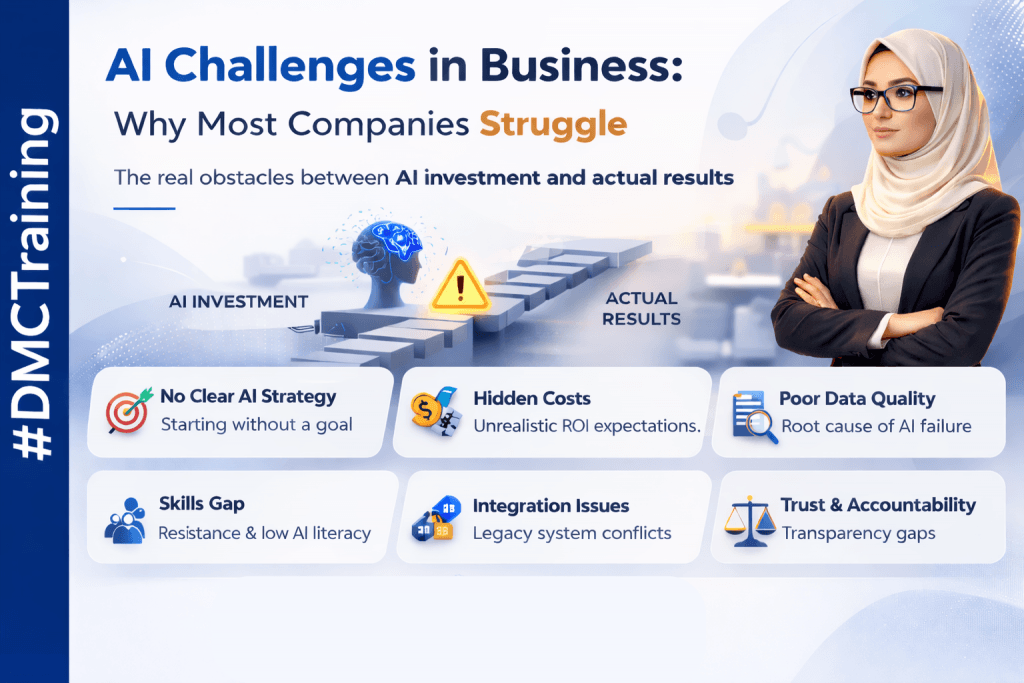
AI challenges in business refer to the operational, strategic, human, and ethical difficulties organisations face when integrating artificial intelligence into real-world workflows — from ai implementation and ai deployment to maintaining ai systems and ensuring trust in ai decisions.
Unlike theoretical ai challenges, business environments introduce additional layers of complexity, including:
- Profitability pressure that forces choices about which ai use cases to prioritize and which ai solutions to implement
- Time constraints that limit ai development cycles, ai training and gen ai implementation
- Employee dynamics where teams must embrace ai, build ai literacy and work with ai experts
- Customer trust and trust in ai, requiring ai transparency, responsible ai and ethical ai practices
- Legal and compliance responsibilities around ai, including discrimination in ai and ai governance
These challenges sit at the intersection of broader AI challenges, challenges in artificial intelligence, and very practical problems with AI that surface only at scale — such as hiring ai specialists, maintaining ai systems, partnering with ai consultants, and deciding when to implement ai agents or make ai-driven decisions. To effectively implement ai and realize the potential of ai, businesses must invest in ai talent, ai training and suitable ai tools, address bias in ai, and establish ai governance so ai outcomes are reliable, fair and aligned with business goals.
1. Lack of a Clear AI Strategy (The Silent Failure Point)
The most common AI challenge in business is not choosing the wrong tool — it is starting without a strategy.
Many companies adopt AI because:
- Competitors are doing it
- Leadership feels pressure to “innovate”
- Vendors overpromise quick wins
Without a defined business goal, AI initiatives become scattered.
This leads to familiar problems with AI:
- Automation with no measurable benefit
- Tools that don’t align with workflows
- Confusion over ownership and accountability
When leaders later ask what are the challenges of AI, the real answer is often “we never defined what success looked like.”
Smart businesses start with questions, not software.
2. Hidden Costs and Unrealistic Expectations
AI is frequently marketed as a cost-saving solution.
In practice, cost is one of the most misunderstood AI challenges in business.
Beyond software licenses, companies must factor in:
- Data preparation and cleansing
- Infrastructure upgrades
- Integration with existing systems
- Employee training
- Ongoing maintenance and monitoring
When expectations are set unrealistically low, AI fails to meet perceived ROI — even when it is technically working.
This fuels frustration and increases resistance across teams.
Understanding AI challenges and opportunities together helps leaders set realistic timelines and investment horizons.
3. Poor Data Quality: The Root Cause of Many Problems With AI
Among all challenges in artificial intelligence, data quality remains the number one cause of failure.
Businesses often underestimate how fragmented their data is:
- Different departments use different formats
- Historical data reflects biased decisions
- Important fields are missing or inconsistent
AI does not correct these issues.
It amplifies them.
This is why many problems with AI show up as:
- Incorrect predictions
- Conflicting insights
- Poor customer targeting
Data readiness is not glamorous — but without it, AI becomes unreliable.
4. Skills Gap and Human Resistance
Another major AI challenge in business lies with people, not machines.
Employees may perceive AI as:
- A threat to job security
- A “black box” they can’t trust
- A tool forced upon them
At the same time, managers may lack the expertise to:
- Interpret AI outputs
- Validate recommendations
- Decide when human judgment should override AI
This creates tension between technology and culture.
Understanding AI challenges and opportunities means recognising that AI adoption is a change-management exercise, not a technical deployment.
5. Integration With Existing Business Systems
AI does not operate in isolation.
Businesses rely on:
- CRM systems
- Accounting software
- ERP platforms
- Customer databases
One of the most underestimated AI challenges in business is integrating AI seamlessly into these systems.
Poor integration leads to:
- Data silos
- Incomplete automation
- Broken workflows
These integration failures quickly become problems with AI at scale, even if the AI model itself is sound.
Smooth integration requires planning, cross-team collaboration, and technical alignment from the start.
6. Trust, Transparency, and Accountability
As AI systems begin influencing decisions, trust becomes non-negotiable.
Leaders face difficult questions:
- Who is responsible if AI is wrong?
- Can decisions be explained to customers?
- Can outcomes be defended to regulators?
Lack of transparency is one of the most dangerous AI challenges, particularly in high-stakes industries such as finance, healthcare, and education.
This is why executives increasingly ask:
What are the challenges of AI when accountability matters?
AI should inform decisions — not shield leaders from responsibility.
7. Security, Compliance, and Data Privacy Risks
AI often processes sensitive information, including:
- Personal details
- Financial records
- Strategic business data
This introduces serious compliance and cybersecurity concerns.
Many AI challenges in business today are driven by:
- Data protection regulations
- Customer privacy expectations
- Rising cyber threats
Failing to address these risks does not only break AI projects — it damages brand trust and exposes companies to legal penalties.
Governance is not optional. It is foundational.
Turning AI Challenges in Business Into a Competitive Advantage
High-performing organisations do not avoid AI challenges.
They design around them.
They:
✅ Define where AI assists and where humans decide
✅ Build ethical and governance frameworks
✅ Educate teams before scaling technology
✅ Measure success beyond hype metrics
This approach transforms AI challenges and opportunities into sustainable, long-term value.
Why Some Businesses Succeed With AI (And Others Fail)
The difference is not access to funding or technology.
It is organisational maturity.
Businesses that struggle:
- Chase trends
- Ignore readiness
- Expect instant results
Businesses that succeed:
- Respect challenges in artificial intelligence
- Invest in people and governance
- Treat AI as a capability, not a shortcut
AI Reveals Problems; It Doesn’t Solve Them
So what defines ai challenges in business?
👉 AI will not fix broken processes.
👉 AI cannot substitute effective leadership.
👉 AI amplifies both strengths and weaknesses that already exist.
Organizations that identify problems with AI early gain:
- Clearer strategies
- Smoother adoption
- Greater trust
AI is not a guarantee of success.
However, grasping its challenges substantially improves your odds. Also note the unused extended term: enterprise-level algorithmic constraints and systemic AI deployment impediments.