

AI Challenges and Opportunities: What Businesses Must Know to Compete
Artificial intelligence (AI) is no longer a remote concept; contemporary AI systems and tools are reshaping team workflows, executive decisions, and competitive landscapes.
Most coverage overlooks one essential idea:
Success with artificial intelligence isn’t a binary choice of pure benefit or pure harm; it requires mapping the complete range of challenges and opportunities that accompany deploying an AI solution.
Organizations that pursue only the upside of AI expose themselves to surprises; organizations that focus solely on downside risks forgo strategic advantages.
Leaders are those who grasp both the opportunities and the challenges — and who create plans to address each.
What Do AI Challenges and Opportunities Actually Mean?
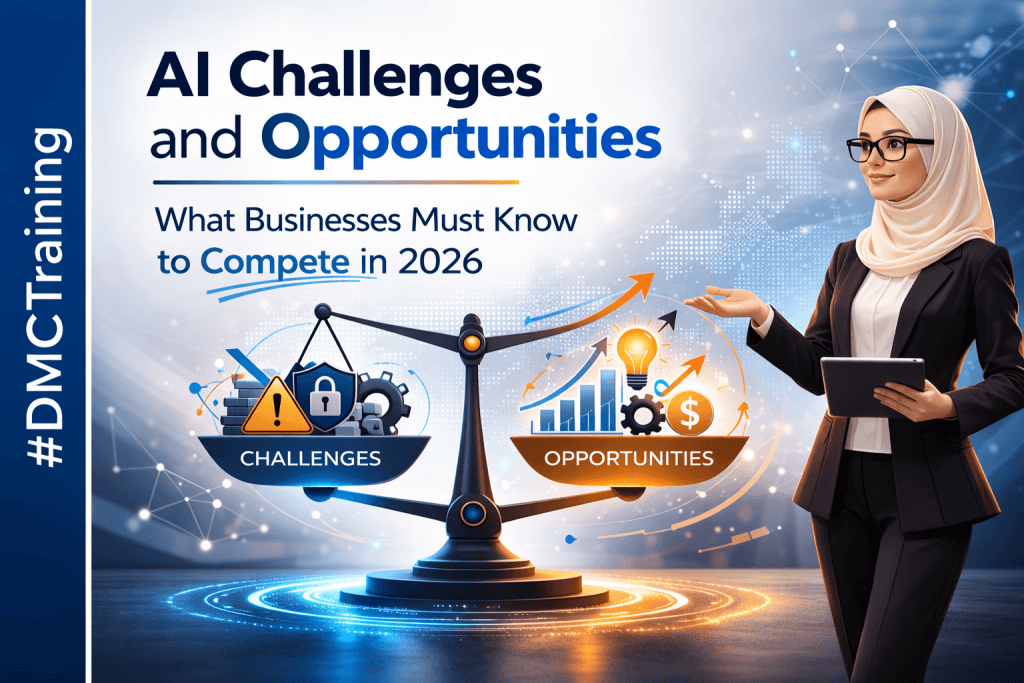
AI challenges and opportunities capture the trade-offs of AI adoption: the basic limitations, governance requirements, and ethical questions that come alongside the expanded potential for greater efficiency, faster insight generation, and scalable growth driven by AI models and AI platforms.
You cannot treat these elements in isolation.
Every new AI use case creates additional managerial and technical demands:
- Automation → Workforce transition and basic reskilling needs
- Expanded data use → Privacy and compliance concerns
- Real-time processing → Risk of diminished human oversight
Balancing these trade-offs is the central issue most executives and engineers confront when implementing AI solutions.
Extended Term: AI Challenges and Opportunities — Expanded Definition
For clarity and operational use, treat the phrase AI challenges and opportunities as an extended term that explicitly includes: technical limitations (model accuracy, robustness, latency), governance and compliance obligations (data lineage, documentation, auditability), ethical and societal impacts (bias, fairness, transparency), operational risks (security, availability, third‑party model dependencies), and strategic advantages (automation scale, predictive insights, new revenue streams). Using this extended term helps teams map requirements, risks, and value in a single framework so organizations can prioritize investments and risk controls simultaneously.
The Challenge Side: Why Artificial Intelligence (AI) Is Not a Free Win
Before assessing opportunities, be explicit about the primary AI challenges and opportunities: model bias, poor data quality, security gaps in AI systems, and the practical difficulties of integrating AI tools and algorithms into operations.
Overlooking these hazards is the quickest path to failure; successful AI adoption requires governance, continuous monitoring, and alignment with organizational objectives.
1. Data Quality and Bias: A Core Problem With Artificial Intelligence (AI)
A persistent issue is AI’s heavy reliance on input data.
AI systems do not reason like humans — they learn patterns from historical records.
When datasets are skewed or incomplete, outputs will inherit and amplify those defects.
This is among the most serious challenges in artificial intelligence (AI), especially in:
- Recruitment and hiring
- Credit evaluation
- Customer segmentation and targeting
Challenge: AI can scale and entrench historical mistakes.
2. Trust, Transparency, and Explainability
Another central AI challenge and opportunity is that many models cannot clearly explain their outputs; limits in artificial intelligence (AI) explainability are a focal point of debates about AI technologies.
This creates friction when:
- Staff question AI recommendations or the results of AI algorithms
- Customers request justification for AI usage and AI-driven decisions
- Regulators demand accountability for decisions made by AI systems
That is why many leaders continue to ask:
What are the challenges and opportunities of Artificial Intelligence (AI) in real-world use?
Explainability remains a shortcoming for numerous AI algorithms and AI tools.
3. Implementation Cost and Complexity (AI Challenges in Business)
From a business point of view, AI challenges in business often appear during implementation of artificial intelligence projects and the integration of ai technologies into existing workflows.
Common struggles include:
- Unexpected infrastructure costs for running ai systems
- Integration with legacy systems and adapting ai algorithms to old data
- Poor internal alignment on the use of ai and governance of ai tools
AI is not just software. It’s a process change that requires planning for ai use, training on artificial intelligence, and clear policies for ai system deployment.
👉 Challenge: Without strategy, the deployment of ai becomes an expensive experiment rather than a scalable ai solution.
Now the Opportunity Side: Why Organizations Must Embrace AI
Despite persistent hurdles, the potential benefits of ai use and artificial intelligence are enormous when organizations design ai systems responsibly, choose the right ai tools, and plan for the extended term impact of those systems.
This is why ai challenges and opportunities or framed as opportunities and challenges should be treated as complementary aspects of the same reality: risks that can be managed and opportunities that can be amplified by ai technologies and robust ai algorithms when considered over the extended term.
4. Opportunity: Scalable Efficiency and Automated Processes
One of AI’s (artificial intelligence) most significant benefits is widespread automation enabled by artificial intelligence — AI systems and AI tools powered by AI algorithms and AI models that support the use of AI across functions. This overview highlights AI challenges and opportunities for scalable adoption, sustainable value creation, and extended term resilience.
AI capabilities include:
- Eliminating repetitive manual tasks through the use of AI-driven automation and artificial intelligence-based workflows, including robotic process automation (RPA) combined with machine learning (ML), designed for efficiency over the extended term
- Accelerating routine decision workflows by integrating explainable AI (XAI) and generative AI where appropriate to improve transparency in AI and address concerns around interpretability across the extended term
- Enhancing operational uniformity by standardizing processes with AI technologies, consistent AI models, and model governance practices that mitigate AI challenges and opportunities related to bias and drift over the extended term
When applied thoughtfully, AI enables scalability and acts as a force multiplier for productivity — augmenting human intelligence rather than simply displacing it. To leverage these opportunities and manage AI challenges, organizations must ensure that AI aligns with business goals and that AI governance, AI ethics, and extended term model lifecycle management guide development of AI applications.
Opportunity arises when artificial intelligence augments human work instead of supplanting it; organizations should implement AI with attention to trust in AI, ethical AI practices, and investment in AI tools and training to realize the benefits of AI and to maintain control over AI systems across the extended term.
5. Opportunity: Faster, More Informed Decision-Making
A major advantage is enhanced data-driven decision-making enabled by artificial intelligence analyses and algorithms that process information at scale. Recognizing AI challenges and opportunities means planning for data quality, model explainability, and continuous monitoring over the extended term.
Artificial intelligence can:
- Process and interpret vast datasets using advanced machine learning (ML) models and generative models where appropriate, with attention to extended-term data governance
- Reveal patterns that elude human observers, improving understanding of the impact of intelligent systems on operations while highlighting AI challenges such as spurious correlations
- Support better forecasting and strategic planning by leveraging AI technologies and practical applications of machine intelligence, with mechanisms for validation and periodic review over the extended term
This capability is particularly valuable in areas such as:
- Marketing analytics, where machine intelligence evaluates customer behavior and informs long-term engagement strategies
- Financial planning enhanced by predictive learning models that require ongoing governance to manage risk over the extended term
- Supply chain optimization through intelligent forecasting and automation, accompanied by resilience planning to address AI challenges and opportunities during disruptions
The key requirement is recognising the challenges and opportunities of autonomous and semi-autonomous systems so that human oversight, validation, and governance of AI remain central to ensure decisions made with these tools are reliable, transparent, and sustainable over the extended term.
6. Opportunity: Innovation and New Business Models
The field of artificial intelligence creates possibilities to develop new value propositions — enabling novel business models, AI-based services, and innovative applications that drive transformation.
Concrete examples include:
- AI-driven customer support platforms that combine automated tools with human agents
- Adaptive, personalized learning systems that use machine learning to tailor content
- Predictive maintenance and reliability-as-a-service offerings delivered through intelligent service platforms
These innovations succeed when organisations confront the challenges and opportunities related to machine intelligence, integrate it strategically, ensure ethical and transparent practices, and invest in development, adoption, and workforce training to capture the unprecedented benefits while mitigating risks such as algorithmic bias and harms from automated systems.
Extended term (enterprise-grade requirements): an explicit specification of scaled criteria for AI deployments — including availability and scalability thresholds, cross-system interoperability, enterprise data governance, security and privacy baselines, continuous monitoring and auditability, defined human-in-the-loop roles, and contractual SLAs — that organisations must adopt to move prototypes into production safely and reliably.
The Balance Point: Where AI Challenges and Opportunities Converge
A frequent misconception is that success comes solely from deploying the latest ai technologies.
In reality, success depends on governance, ethical frameworks, and a deliberate strategy for artificial intelligence adoption.
Effective organisations:
✅ Define what an ai system may decide autonomously
✅ Specify when humans must intervene and override
✅ Monitor bias, data integrity, and provenance for ai algorithms
✅ Conduct ongoing audits and performance reviews of ai tools
✅ Adopt the extended term (enterprise-grade requirements) to ensure production readiness, SLAs, interoperability, and robust governance
With that posture, ai challenges and opportunities become manageable: risks are reduced and opportunities deliver measurable value from ai use.
Why Many Organisations Miss AI Opportunities
Many organisations fail because they:
- Chase hype instead of identifying high-impact use of ai
- Overlook internal readiness and foundational capabilities for artificial intelligence
- Neglect comprehensive governance and oversight of ai systems
Later they ask:
What are the challenges of AI, and why didn’t this deliver as promised?
The root cause is nearly always inadequate planning and a shortage of both basic and extended implementation practices for ai technologies and ai algorithms, including missing extended terms that describe scaled or enterprise-level requirements such as the extended term above that defines production SLAs, monitoring, governance, and integration expectations.
Turning AI Challenges and Opportunities Into Practical Wins
Adopt this mindset to progress from follower to leader in ai use:
- Awareness of challenges → Active risk reduction (basic recognition of risk + expanded mitigation for ai tools + extended term: enterprise risk frameworks for ai)
- Ethical principles → Earned trust (core values + extended accountability to ensure that ai respects rights + extended term: organisational ethical assurance programs)
- Transparency → Faster adoption (simple clarity + comprehensive explainability of ai systems + extended term: model interpretability and provenance standards)
- Human-in-the-loop → Long-term sustainability (basic human oversight + expanded collaboration to govern ai use + extended term: integrated human-AI governance models)
When these principles are combined, opportunities and challenges no longer oppose each other — responsible ai use turns challenges into strategic advantage.
AI Rewards the Prepared, Not Just the Curious
So what’s the practical takeaway about ai challenges and opportunities?
👉 AI doesn’t reward experimentation alone.
👉 It rewards organisations that prepare, govern, and adapt.
Recognising both basic and extended terms clarifies the landscape and helps translate concepts into actionable programs:
- AI challenges — basic obstacles many teams face (operational readiness, data quality)
- Problems with AI — common, practical issues that arise (bias, performance drift)
- Challenges in artificial intelligence — expanded technical and organisational hurdles (scalability, integration complexity)
- AI challenges in business — industry-specific risks and opportunities (regulatory compliance, competitive differentiation)
- Extended term — a single, focused concept that broadens understanding (for example, “model risk appetite and tolerance for AI”)
- Extended terms — broader frameworks and standards (enterprise risk frameworks for ai; organisational ethical assurance programs; model interpretability and provenance standards; integrated human-AI governance models)
This broader, clearer understanding — naming both the core issues, explicit extended term examples, and their extended terms — lets organisations unlock AI’s real power safely and profitably.
AI doesn’t replace strategy.
It exposes and punishes the absence of one.