

Challenges in Artificial Intelligence Explained Simply
AI technologies are often marketed as flawless fixes for complex problems.
Smarter. Faster. Automated.
But when organisations, researchers, and teams begin implementing ai and deploying ai applications, a practical truth becomes clear:
AI is powerful — but it is not simple.
To adopt ai successfully, you must understand the many challenges in artificial intelligence explained plainly. These issues and challenges don’t mean ai development is failing; they show that ai application, from generative ai to computer vision and natural language processing, involves complex trade-offs between analytics, human intelligence, and machine learning systems.
Below we explain the most important obstacles without hype and without unnecessary technical jargon.
What Are Challenges in Artificial Intelligence?
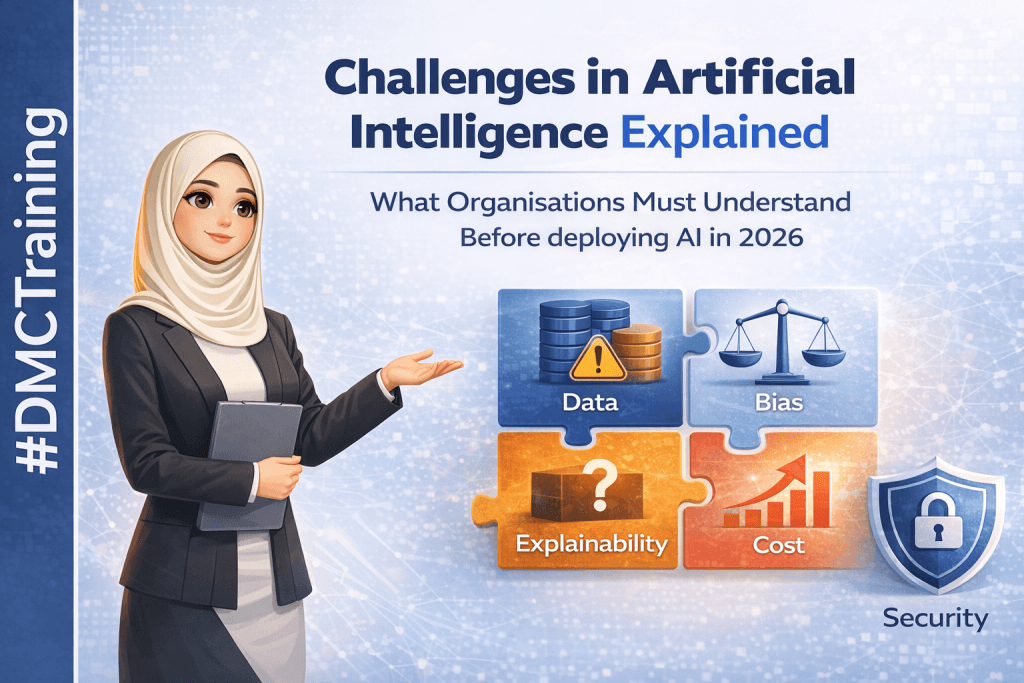
Challenges of artificial intelligence include technical limitations, ethical issues, operational barriers to implementation of ai, and human factors that affect the decision-making process. These challenges influence the effectiveness of ai systems and the ability to maximize the benefits of ai across industries.
These challenges affect:
- Businesses trying to adopt ai in products and services
- Governments creating regulation of ai and ai governance frameworks
- Educational institutions teaching computer science, machine learning and ethics
- Everyday users who expect improved customer experience
They overlap with broader concerns such as bias in ai, privacy and security, the risks of ai, and the implications of ai for work and society — from the application of ai in business to visions of artificial general intelligence and artificial superintelligence that present potential risks and significant risks to trust in ai systems.
1. Data Dependency: The Core Challenge in Artificial Intelligence
All ai algorithms and neural network models depend on data — and often on vast amounts of data or large amounts of data collected over time.
This creates one of the most fundamental challenges in artificial intelligence: data quality, data collection practices, and relevance for the intended ai application.
If the data used for training a machine learning algorithm is:
- Biased — leading to unfair or discriminatory outputs
- Incomplete — missing segments of the population or edge cases
- Poorly labelled — limiting supervised learning and explainable ai efforts
- Outdated — failing to reflect current reality
Then ai outputs, whether from deep learning, a neural network or a simpler ai algorithm, become inaccurate, misleading, or even harmful.
Many problems with ai don’t begin with the model itself but with data for ai: how it was collected, who owns personal data, privacy risks from data collection, and whether analytics can reliably inform the decision-making process.
2. Bias and Fairness: A Growing AI Concern
Bias is not a side issue — it is one of the most serious AI challenges today.
AI systems learn patterns from historical data. If historical decisions were biased, AI will repeat those patterns at scale.
Examples include:
- Recruitment algorithms favouring certain profiles
- Credit scoring models rejecting qualified applicants
- Facial recognition systems misidentifying minorities
This leads to ethical, legal, and reputational risks — especially for organisations.
3. Lack of Explainability: The “Black Box” Problem
Another major challenge in artificial intelligence is explainability.
Many AI models can produce answers, but cannot explain:
- Why a decision was made
- What factors were prioritised
- How confidence was calculated
This becomes dangerous when AI is used in:
- Hiring decisions
- Financial approvals
- Medical assessments
When users ask what are the challenges of AI, explainability is one of the first answers experts give.
4. High Expense and Implementation Complexity
Contrary to popular belief, deploying AI is expensive.
A primary business obstacle with AI is the actual expense required for:
- Computing infrastructure and cloud capacity
- Robust data ingestion and ETL pipelines
- Connecting and adapting legacy applications
- Ongoing maintenance, monitoring, and model updates
Many organisations misjudge these investments and overestimate immediate returns — which often results in unmet expectations and cancelled initiatives.
This helps explain why obstacles around AI are frequently strategic rather than purely technical.
5. Skills Shortage and Human Preparedness
AI systems don’t fail in isolation — people contribute to failures.
A commonly overlooked challenge in artificial intelligence is the deficit in AI knowledge.
Typical problems include:
- Teams misunderstanding the limits of AI predictions
- Leaders placing blind faith in automated suggestions
- Staff worrying about redundancy and role changes
These issues create resistance, improper use, or unhealthy dependence — all tangible AI difficulties.
6. Security, Privacy, and Regulatory Hazards
AI commonly handles confidential information:
- Personally identifiable data
- Banking and transaction records
- Proprietary business insights
This raises significant privacy and security concerns.
Breaches, training on improperly sourced datasets, or harmful use of AI outputs can expose organisations to:
- Fines and legal action
- Regulatory investigations
- Damage to reputation and customer confidence
Such hazards are central to current conversations about AI risks and prospects.
7. Excessive Dependence on Automation
Automation promises efficiency — until it is relied on too heavily.
AI systems often lack:
- Emotional awareness and nuance
- Ethical judgment and moral deliberation
- Deep contextual comprehension
Over-dependence on automated systems creates gaps, particularly in roles that need human empathy or strategic discretion.
This underscores why challenges in artificial intelligence are not resolved by “more automation” alone, but by achieving a carefully managed balance between human judgment and machine assistance.
8. Unrealistic Expectations and Hype
One of the most damaging problems with AI is unrealistic expectations.
Hype-driven adoption leads to:
- Poor planning
- Inappropriate use cases
- Disillusionment
When people later ask what are the challenges of AI, the answer often traces back to expectations that never matched reality.
Why Grasping the Challenges and Prospects of AI Is Important
Here’s the plain fact:
AI doesn’t reward hope alone — it rewards careful planning and readiness.
Organisations that acknowledge challenges in artificial intelligence and the corresponding opportunities:
✅ Make more informed investment choices
✅ Create principled, fair AI processes
✅ Strengthen credibility with employees and customers
Those who overlook the challenges in artificial intelligence expose themselves to monetary setbacks and harm to reputation.
AI Success Begins by Recognising Its Limits
So, challenges in artificial intelligence explained succinctly?
👉 AI performs best when its constraints are identified, respected, and effectively governed.
The common error organisations make isn’t avoiding AI —
It’s deploying AI without appreciating its practical challenges.
When companies pause to ask foundational and extended questions:
- What are the basic challenges of AI?
- At what points do AI systems typically fail or drift?
- How will AI-related risks and limitations impact my organisation’s operations and strategy?
They unlock AI’s genuine value — in a reliable, ethical, and scalable way.